
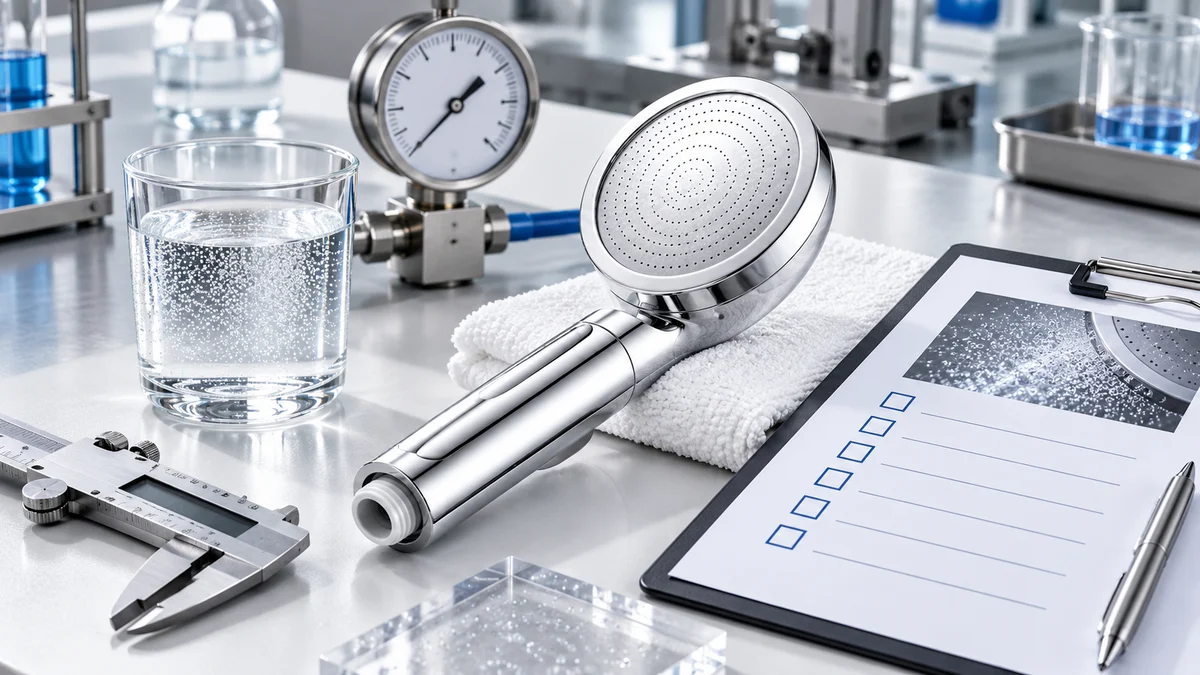
Trust a microbubble claim only when it can be traced to the exact product and a suitable test. Ask what was measured, on which model, by which method, under what conditions, against what control, with what result and uncertainty, and whether the conclusion stays inside that evidence.
The seven-question screen
- Which exact model was tested?
- What property or outcome was measured?
- Was the method suitable for that claim?
- What pressure, flow, temperature, water, and sampling conditions were used?
- What blank, inlet, or comparison control was included?
- How many repeats were run and how variable were they?
- Does the marketing sentence match the report conclusion?
A certificate and a performance result are not the same
A compliance document may address material, electrical, plumbing, or manufacturing requirements without proving bubble size or a cleaning outcome. Read the scope, standard, product identity, issue date, and conclusion rather than relying on a logo or report cover.
Likewise, a bubble-size result does not automatically prove filtration, skin effects, sanitation, water savings, or detergent reduction.
Watch for claim drift
Claim drift occurs when evidence for one component, prototype, condition, or property is reused to support a broader finished-product promise. The further the marketing sentence moves from the measured result, the more additional evidence is needed.
| Evidence | Reasonable statement | Unsupported jump |
|---|---|---|
| Outlet size distribution | Measured bubbles under stated conditions | Guaranteed health benefit |
| Delivered flow test | Flow at stated pressure | Universal water savings |
| One cleaning trial | Result in that trial | Works on every soil and surface |
Ask for the complete evidence pack
A buyer or distributor should be able to review model drawings, test reports, installation limits, maintenance instructions, warranty, and replacement support. Missing operational information can matter as much as a headline laboratory result.
Evidence boundary
This guide separates practical selection advice from unverified performance claims. Results can vary with the exact model, water, pressure, flow, temperature, installation, maintenance, test method, and household task. It does not make medical claims.
FAQ
Common questions
Is third-party testing always required?
It is especially valuable for material claims, regulated claims, and results that buyers cannot verify themselves.
Can customer reviews prove performance?
Reviews can reveal usability questions, but they do not replace controlled, model-specific testing.
What should I do if a supplier will not share a report?
Limit the claim to what can be verified and treat unsupported performance statements as unconfirmed.
Product inquiry
Need model-specific specifications or compatibility help?
Tell us your application, market, connection, pressure range, expected quantity, and evidence requirements.
Request product information