
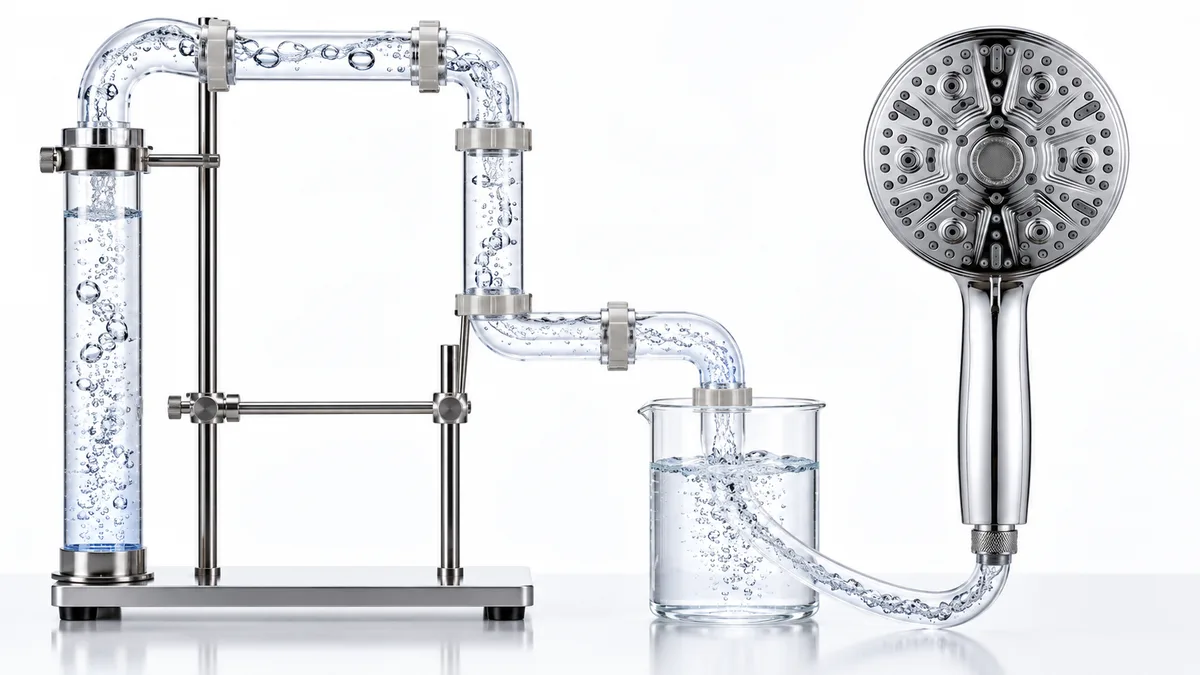
A bubble population can change between its generation point and the shower outlet. Travel time, pressure changes, tubing, fittings, restrictions, temperature, coalescence, dissolution, and sampling can alter what an instrument detects. For a shower-head claim, the most relevant sample is normally taken at a defined outlet location under stated operating conditions.
Generation is only the beginning
A mixing chamber or internal passage creates a starting population. The water then moves through channels, valves, screens, hose sections, and spray outlets. Each part changes local velocity and pressure and may affect the observed population.
A test performed directly beside a laboratory generator should not automatically be described as shower-outlet performance.
Why the population may change
- Coalescence: bubbles may merge into larger bubbles.
- Dissolution: gas may transfer into the surrounding water.
- Pressure change: expansion or contraction can affect size.
- Residence time: a longer path allows more change before sampling.
- Surfaces: tubing and fittings can trap or release gas and particles.
- Sampling: pouring, storage, or delay can disturb the sample.
Choose a sampling point that answers the claim
| Claim | Relevant sampling approach |
|---|---|
| Generator output | Defined point immediately after the generator |
| Delivered shower water | Defined position at the operating shower outlet |
| Persistence | Repeated measurements at stated elapsed times |
| Product comparison | Matched supply and sampling procedure for both products |
Document the complete path
A useful diagram lists the generator position, tubing length and material, connectors, filters or screens, shower mode, sample point, and elapsed time. Photographs of the setup help reviewers determine whether the test represents normal use.
The goal is not to claim that every change is beneficial or harmful. It is to make the measurement traceable and repeatable.
Evidence boundary
This guide explains how to evaluate a claim. It does not state that every microbubble or nanobubble product achieves the same result. Product conclusions must match the exact model, method, operating conditions, sampling procedure, controls, and report scope.
FAQ
Common questions
Should a test sample come from a cup filled by the shower?
It can, if the collection method, cup, timing, and handling are defined and suitable for the instrument.
Does a longer hose always reduce bubble performance?
Not necessarily. The effect depends on the complete system and must be measured rather than assumed.
Why compare inlet and outlet water?
The comparison helps separate background particles and water conditions from changes associated with the tested device.
Product evidence
Need model-specific specifications or test information?
Tell us the model, market, connection, pressure range, and evidence you need to review.
Request product information