
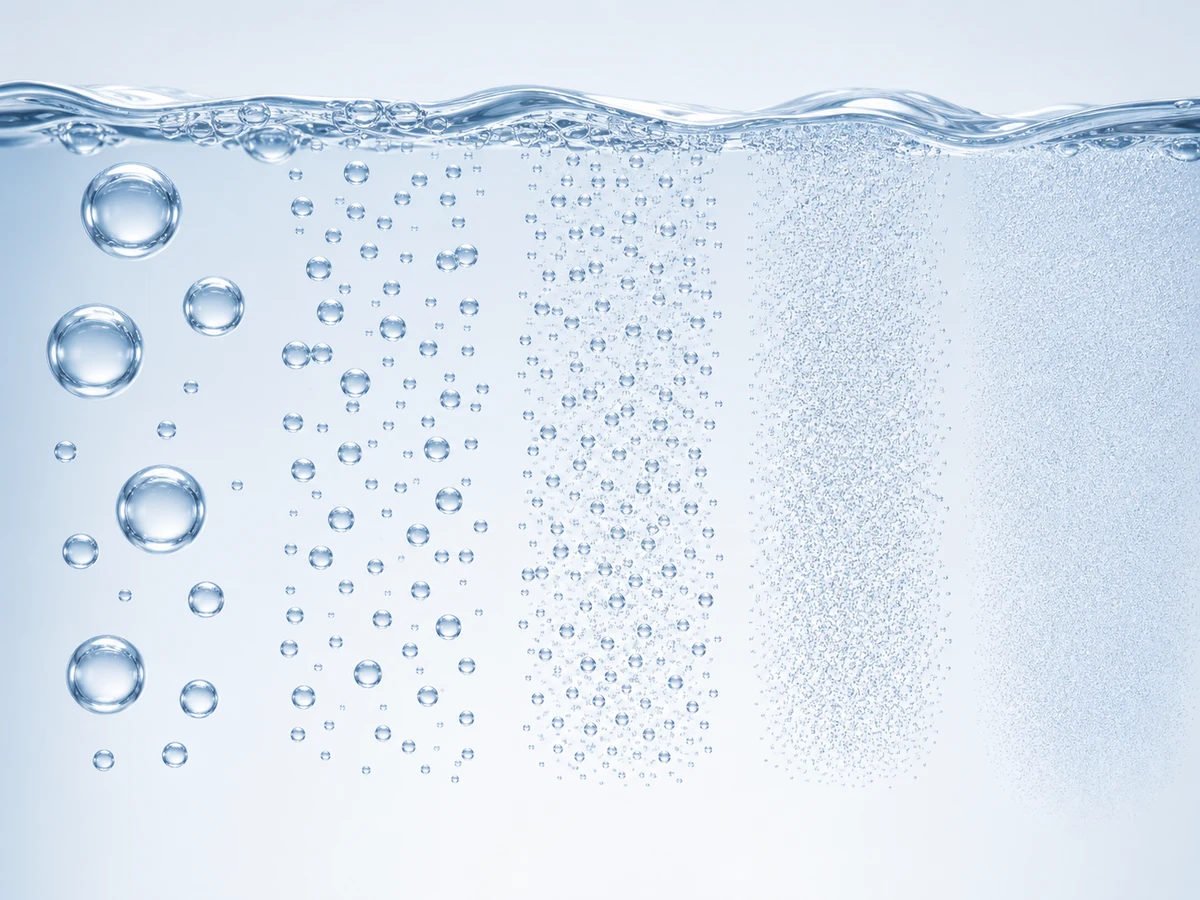
Fine bubble is an umbrella term, while microbubble and ultrafine bubble describe different size ranges under recognized terminology. A shower-head label alone does not prove bubble size or concentration. Useful comparisons identify the exact model, generation method, measurement instrument, sampling procedure, water pressure, flow, temperature, and test date.
Why terminology matters
Words such as fine, micro, nano, and ultrafine are often used loosely in product marketing. For technical comparison, buyers should ask which standard or definition is being followed and whether the reported measurement actually covers the claimed size range.
A cloudy stream can show that air is present, but visibility is not a particle-size measurement. Very small bubbles may not be visible individually, while larger bubbles can make water look white for a short time.
What changes the measured result
Water pressure, flow rate, temperature, dissolved gas, sampling point, time after generation, container handling, and measurement equipment can all affect results. Two reports are not directly comparable when these conditions differ.
A useful report identifies the sample, product configuration, instrument, method, repeated measurements, and operating conditions. A single image without those details is evidence of appearance, not a complete technical characterization.
How to compare two shower heads
| Check | Why it matters |
|---|---|
| Exact model | Prevents results from another product being reused |
| Pressure and flow | Generation can change with operating conditions |
| Instrument and range | Not every method measures the same sizes |
| Sampling time | Bubble populations can change after collection |
| Repeated results | Shows whether the result is consistent |
Use the label as a starting point
A strong buying decision combines terminology with practical information: connection size, usable pressure, flow, spray pattern, materials, cleaning method, replacement parts, warranty, and supplier support. The best label is the one backed by a clear product specification and traceable evidence.
Evidence note
Product claims should be matched to the exact model, report, method, and operating conditions. Installation and results can vary with water pressure, water quality, maintenance, and local plumbing. This guide does not make medical claims.
FAQ
Common questions
Does white-looking water prove nanobubbles?
No. Appearance alone cannot establish a particle-size distribution.
Are smaller bubbles always better?
Not in every application. Performance depends on concentration, flow, contact conditions, product design, and the task.
What report should a buyer request?
Request a report that names the exact model and states the instrument, method, pressure, flow, sampling conditions, and results.
Product inquiry
Need model-specific specifications or compatibility help?
Tell us your market, connection, pressure range, expected quantity, and customization needs.
Request product information