
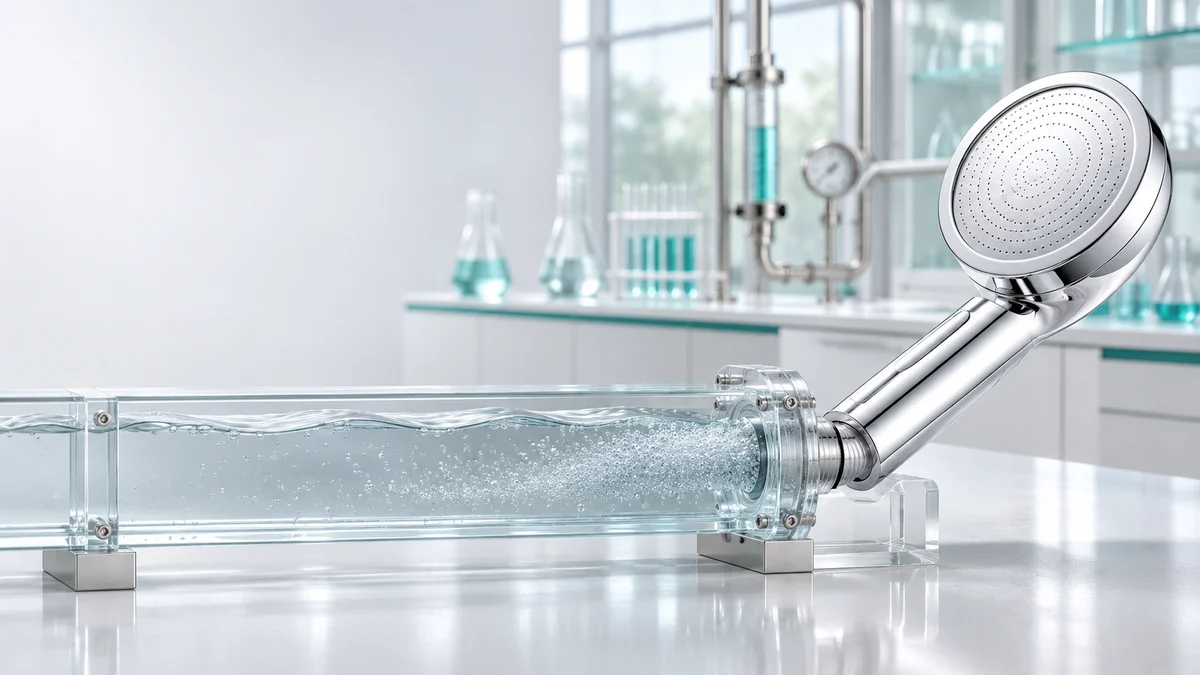
The defining feature of a microbubble is size, not a marketing benefit. Under ISO fine-bubble terminology, microbubbles are generally 1 micrometer to less than 100 micrometers in diameter. Their small size changes surface-area-to-volume ratio, rise behavior, gas transfer, and how they interact with surfaces, but does not automatically prove cleaning, filtration, sanitation, or health outcomes.
Feature 1: a defined size range
ISO 20480-1:2017 separates microbubbles from ultrafine bubbles. “Nano,” “milky,” and “oxygen-rich” are not substitutes for a measured distribution. A credible claim states the instrument, weighting method, concentration, sample point, and operating conditions.One average value can hide a wide population. Ask whether the chart is number-weighted or volume-weighted and whether larger particles or bubbles fall outside the instrument range.
Feature 2: high interface relative to gas volume
As bubble diameter decreases, the total gas-water interface can increase for the same gas volume. This is relevant to mass transfer and surface interaction, but the practical result still depends on concentration, water chemistry, contact time, flow, and the application.
| Feature | What it may influence | What it does not prove |
|---|---|---|
| Small diameter | Rise rate and interface | Health benefit |
| Cloudy plume | Light scattering | Exact bubble size |
| Longer persistence | Time in the water | Filtration or sterilization |
| Fine outlet flow | Contact and spray feel | Universal cleaning result |
Feature 3: behavior depends on the system
Pressure, temperature, dissolved gas, flow, restrictions, tubing, and sampling delay can change what reaches the outlet. A generator result measured beside the mixing chamber may not describe water delivered after a hose and fixture.
Product evidence should therefore identify the complete configuration and the location where the sample was collected.
Feature 4: useful only when matched to a task
Fine bubbles are studied in water treatment, aquaculture, flotation, cleaning, and other fields, but evidence from one system cannot be transferred automatically to a household faucet or shower. Evaluate the exact model and intended task.
Evidence boundary
This guide separates terminology and practical selection from unverified outcomes. Conclusions must match the exact model, method, operating conditions, sampling procedure, controls, report scope, and target market. It does not make medical claims.
FAQ
Common questions
What is the key feature of a microbubble?
Its measured diameter falls within the microbubble range; other behaviors depend on the complete system.
Can you see microbubbles?
Some larger microbubbles may contribute to visible cloudiness, but appearance cannot identify the full distribution.
Are microbubbles the same as nanobubbles?
No. Ultrafine bubbles are below 1 micrometer under ISO terminology.
Product inquiry
Need model-specific specifications or OEM support?
Tell us your application, market, connection, pressure, flow, quantity, and evidence requirements.
Request product information