
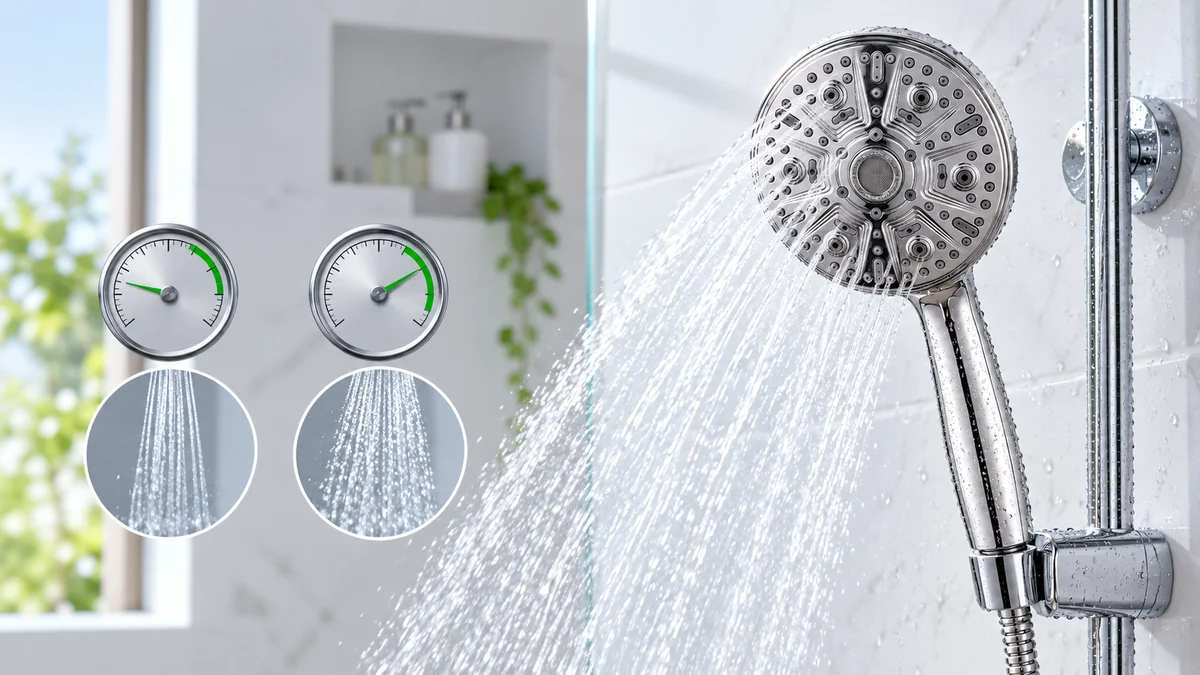
A microbubble shower head can change flow rate, spray velocity, and perceived force, but those are not the same as household water pressure. The result depends on inlet pressure, internal passages, flow controls, spray outlets, hose condition, and scale or debris. Compare performance at stated pressures and clean the inlet before assuming the product is defective.
Pressure, flow, and spray feel are different
Pressure is the force available in the plumbing system. Flow is the volume delivered over time. Spray feel also depends on how that flow is divided among outlets and the velocity of each jet.
A shower head may use less water while producing a focused spray, or it may feel weak when the inlet pressure is below its intended range. A single marketing phrase such as “high pressure” does not explain these relationships.
Common causes of weak or uneven flow
- Low inlet pressure at the property
- A kinked or restricted shower hose
- Debris in the inlet screen
- Scale in spray outlets or internal passages
- An incompatible adapter or displaced washer
- A selected spray mode that divides flow across more outlets
Check simple installation and maintenance causes before changing the plumbing. If other fixtures also have low flow, the issue may be upstream from the shower head.
How to evaluate a product specification
| Ask for | What it tells you |
|---|---|
| Operating pressure range | Where the product is intended to work |
| Flow at stated pressure | A comparable volume measurement |
| Spray-force test | Force under defined conditions |
| Water-efficiency report | Performance of the tested sample |
The GXZR-002 sample has a water-efficiency report with flow, uniformity, and spray-force results. These values should always be quoted with the report number, standard, and test conditions.
Troubleshooting order
Confirm the property supply, straighten the hose, remove and inspect the inlet screen, check the adapter and washer, clean deposits according to the manual, and then retest the same spray mode. This sequence is faster and more informative than replacing parts at random.
Evidence note
Product claims should be matched to the exact model, report, method, and operating conditions. Installation and results can vary with water pressure, water quality, maintenance, and local plumbing. This guide does not make medical claims.
FAQ
Common questions
Does a lower flow rate always feel weaker?
No. Outlet design and jet velocity affect spray feel, although sufficient inlet pressure is still required.
Can a clogged screen affect flow?
Yes. Debris at the inlet can restrict water and should be cleaned according to the product instructions.
Are laboratory values guaranteed in every home?
No. Installation, pressure, water quality, hose condition, and maintenance can change actual performance.
Product inquiry
Need model-specific specifications or compatibility help?
Tell us your market, connection, pressure range, expected quantity, and customization needs.
Request product information