
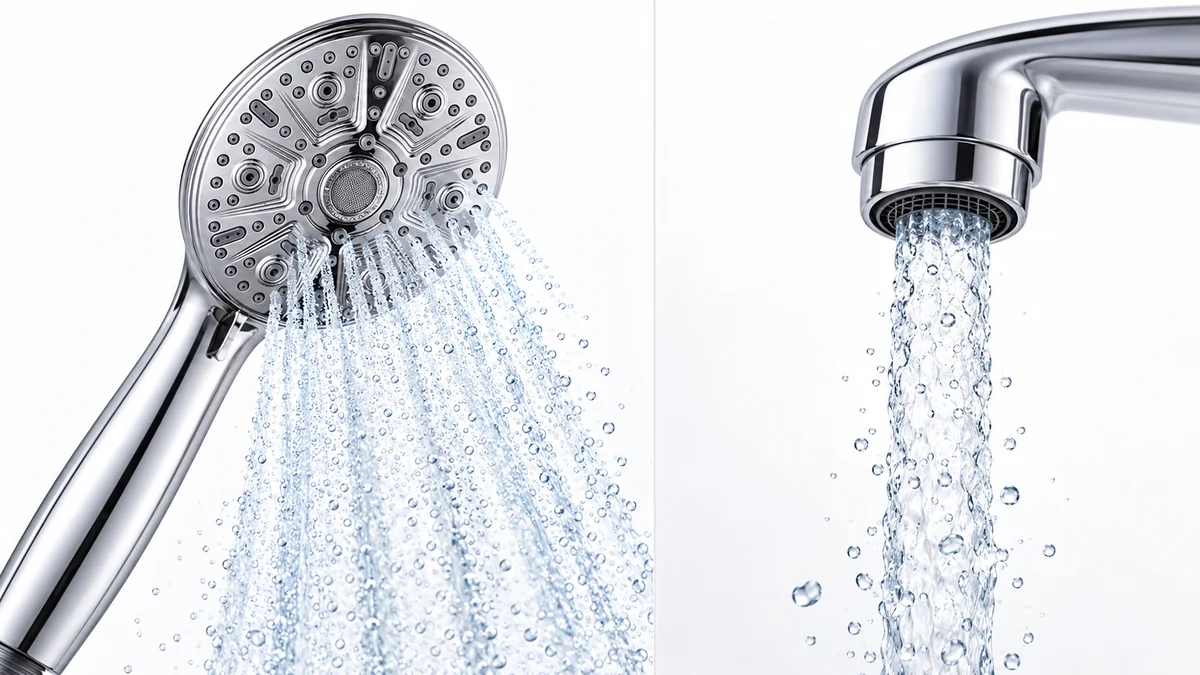
A standard faucet aerator mainly shapes a compact faucet stream and can limit flow. A microbubble shower head uses a larger spray system and an internal air-water structure intended to change the shower stream. Neither name alone proves a particular bubble size, cleaning effect, or filtration result. Compare the exact model, operating conditions, measurement method, connection, and maintenance requirements.
The simple difference
A faucet aerator attaches to a tap outlet and usually combines water with air through a small screen or insert. It is designed for a concentrated sink stream. A shower head divides water among multiple outlets and may include spray modes, flow controls, screens, and an air-intake or bubble-generating structure.
The two products can use related fluid principles, but they are not interchangeable. A sink aerator is not evidence that a shower head produces a defined microbubble or ultrafine-bubble distribution.
What to compare
| Check | Standard aerator | Microbubble shower head |
|---|---|---|
| Typical use | Kitchen or basin faucet | Handheld or fixed shower |
| Outlet | Single compact stream | Multiple spray outlets |
| Connection | Faucet-specific thread | Hose or shower-arm connection |
| Maintenance | Screen and scale cleaning | Inlet screen, outlets, seals, and internal passages |
| Evidence needed | Flow and compatibility | Flow, pressure, spray performance, and bubble test conditions |
Do visible bubbles prove the claim?
No. White-looking water or visible bubbles show that air is present, but appearance alone does not establish particle-size distribution or concentration. A useful test identifies the exact model, instrument, sampling point, pressure, flow, temperature, and time after generation.
Ask for traceable test conditions instead of relying on close-up photographs or broad words such as nano, oxygenated, or high pressure.
Choose by application first
For a sink, begin with faucet thread, swivel range, splash control, and cleaning access. For a shower, begin with hose or arm compatibility, inlet pressure, flow, spray feel, mode switching, and maintenance. Add bubble evidence only after the basic installation and use conditions are clear.
Evidence note
Product claims should be matched to the exact model, report, method, and operating conditions. Installation and results can vary with water pressure, water quality, maintenance, and local plumbing. This guide does not make medical claims.
FAQ
Common questions
Is every aerator a microbubble generator?
No. Aeration does not by itself prove a defined microbubble size range or concentration.
Can a faucet aerator be installed on a shower hose?
Usually not directly. The thread, seal, flow, and intended application must all match.
Does either device filter water?
Not automatically. Filtration requires a specified filter medium and model-specific evidence for the substance being discussed.
Product inquiry
Need model-specific specifications or compatibility help?
Tell us your market, connection, pressure range, expected quantity, and customization needs.
Request product information