
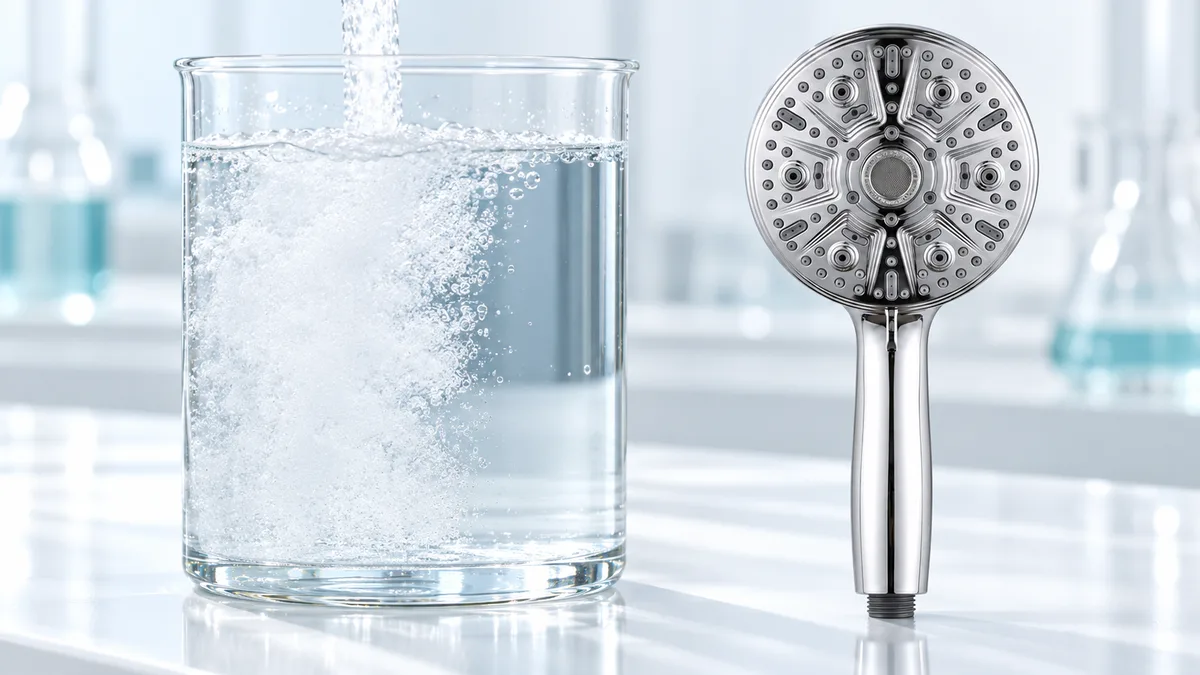
You cannot confirm ultrafine bubbles simply by looking at cloudy water. ISO terminology places ultrafine bubbles below 1 micrometer, while microbubbles range from 1 micrometer to under 100 micrometers. A cloudy plume may include larger bubbles, suspended particles, or several populations at once. Size and concentration require an appropriate measurement method and controlled sampling.
What the eye can actually tell you
A visible white plume shows that light is being scattered. It does not reveal whether the scattering comes from gas bubbles, solid particles, droplets, or a mixture. It also does not provide a reliable diameter distribution.
Larger bubbles may rise, merge, shrink, or disappear within seconds. A photograph taken immediately at the outlet therefore describes a moment, not the full bubble population.
Use standardized words carefully
ISO 20480-1:2017 defines a fine bubble as smaller than 100 µm, a microbubble as 1 µm to under 100 µm, and an ultrafine bubble as smaller than 1 µm. Marketing phrases such as “nano mist,” “oxygen-rich,” or “milky water” do not replace a measured size distribution.
| Observation | What it may show | What it cannot prove |
|---|---|---|
| Cloudy water | Strong light scattering | Ultrafine-bubble size or concentration |
| Bubbles rising | A visible gas phase | The smallest bubbles present |
| Water clears over time | The visible population changed | Why it changed or what remained |
A useful demonstration is not a certification
A side-by-side glass test can help explain outlet behavior when the camera position, lighting, water, temperature, pressure, and timing are recorded. It should be labeled as a demonstration, not presented as a particle-size test.
For a product claim, ask for the exact model, sampling location, elapsed time after generation, instrument, measurement range, number of repeats, and untreated-water control.
What a stronger claim looks like
A defensible statement is narrow: it identifies the measured quantity, test method, conditions, and result for one configuration. It also explains uncertainty and does not turn a bubble measurement into an unrelated health, filtration, or cleaning claim.
Evidence boundary
This guide explains how to evaluate a claim. It does not state that every microbubble or nanobubble product achieves the same result. Product conclusions must match the exact model, method, operating conditions, sampling procedure, controls, and report scope.
FAQ
Common questions
Does milky water mean there are nanobubbles?
Not by itself. Cloudiness is an optical observation, not a size measurement.
Can a phone camera measure bubble size?
A phone can document a plume, but it cannot normally characterize submicrometer bubbles without a validated optical setup and calibration.
Why does bubbly water become clear?
Visible bubbles may rise, merge, shrink, dissolve, or leave the observation area. The mechanism cannot be identified from appearance alone.
Product evidence
Need model-specific specifications or test information?
Tell us the model, market, connection, pressure range, and evidence you need to review.
Request product information