
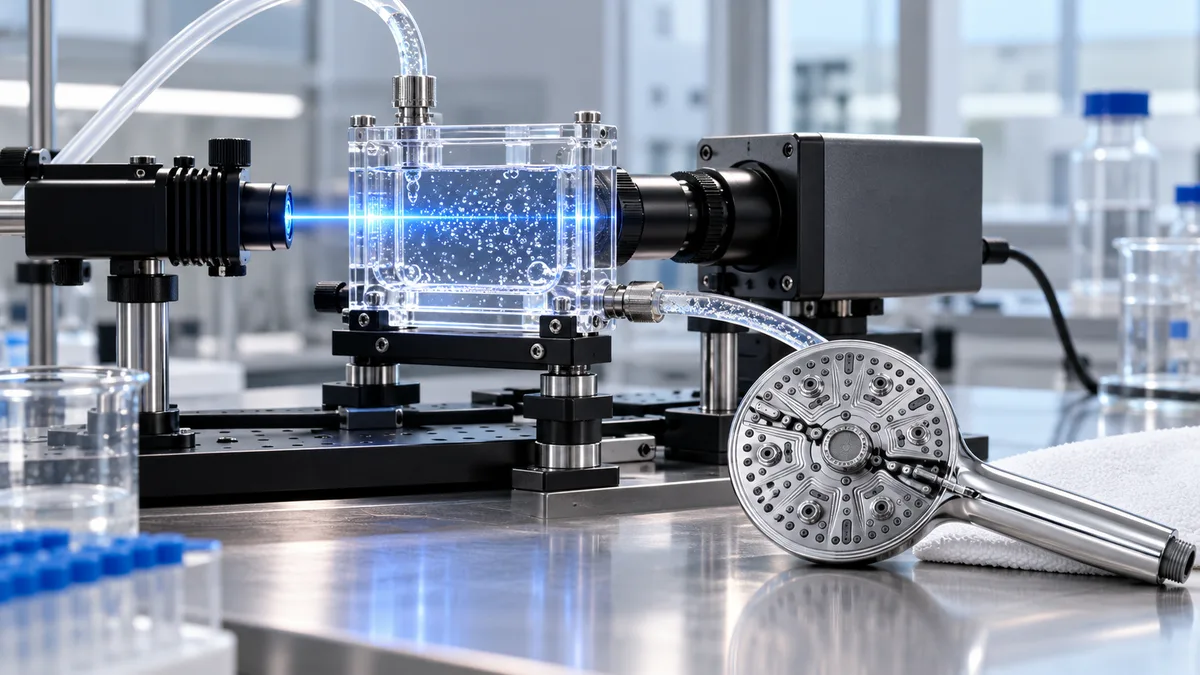
Microbubble measurement is not one universal test. Researchers use methods such as imaging, laser diffraction, light scattering, and particle-tracking approaches, each with a useful range and assumptions. A credible report states the instrument, sample handling, size metric, concentration basis, repeats, controls, and limitations.
Match the method to the size range
Microscopy and high-speed imaging can directly observe some microbubbles when the field of view, focus, calibration, and bubble density are controlled. Laser diffraction estimates a population distribution from scattered light and has been used for microbubble characterization.
For smaller populations, Takahashi et al., Applied Optics (2018) describes combined dynamic and static light-scattering measurements, while Midtvedt et al., Analytical Chemistry (2020) demonstrates an optical approach that also uses refractive-index information to help distinguish bubbles from similarly sized solid material.
One number can hide the distribution
| Report item | Why it matters |
|---|---|
| Mean, median, or mode | Different summaries can describe the same sample differently |
| Number- or volume-weighted | A few large bubbles can dominate a volume result |
| Concentration | Size alone does not state how many bubbles were detected |
| Measurement range | Particles outside the instrument range may be missed |
| Repeatability | Repeated samples reveal variability |
The instrument may detect more than bubbles
Water can contain dust, mineral particles, residue from containers, and material released by tubing. A size distribution alone does not always establish that every detected object is gas. Blank water, cleaned equipment, suitable controls, and an identification method matter.
Ask whether the laboratory measured the untreated inlet water and whether the method can distinguish refractive-index differences or otherwise verify the gas phase.
Questions to ask before accepting a chart
- Was the exact retail model tested?
- Where and when was the sample collected?
- Which instrument and settings were used?
- How were the container and tubing cleaned?
- Were blank and inlet-water controls included?
- How many runs were performed?
- Is raw or replicate data available?
Evidence boundary
This guide explains how to evaluate a claim. It does not state that every microbubble or nanobubble product achieves the same result. Product conclusions must match the exact model, method, operating conditions, sampling procedure, controls, and report scope.
FAQ
Common questions
Is laser diffraction the only valid method?
No. The suitable method depends on size range, concentration, sample behavior, and the measurement question.
What does D50 mean?
D50 is a median diameter under the report’s stated weighting method; half of the measured distribution lies on each side of that value.
Can particle tracking mistake particles for bubbles?
It can be difficult to distinguish them if the method only infers size from motion. Appropriate controls or additional optical information are important.
Product evidence
Need model-specific specifications or test information?
Tell us the model, market, connection, pressure range, and evidence you need to review.
Request product information