
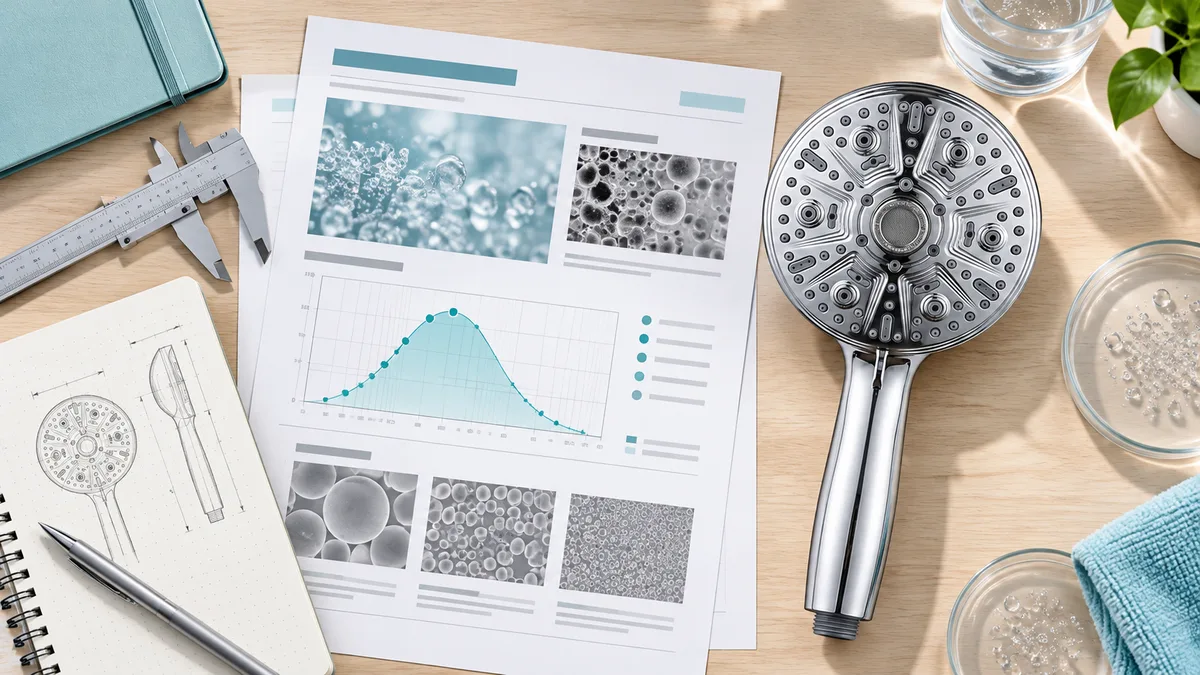
Start with the sample identity and test method, not the headline conclusion. Confirm that the tested item is the same model being sold, then review the operating conditions, measurement range, controls, repeats, result units, uncertainty, and the laboratory’s exact conclusion. Do not extend one measured property into unrelated performance claims.
Step 1: match the sample to the product
Look for model number, sample description, photographs, version, date received, and any accessories used during testing. A report for a generator, insert, or earlier prototype may not apply to the final shower-head assembly.
If the sample was supplied by the manufacturer, the report should still identify it clearly enough for a buyer to make the match.
Step 2: reconstruct the setup
A reader should be able to understand the water source, pressure, flow, temperature, hose, spray setting, stabilization time, sample location, collection container, and delay before analysis. Missing conditions limit how broadly the result can be applied.
Check whether the report measured inlet water, outlet water, blanks, or comparison devices.
Step 3: understand the result table
| Field | Question |
|---|---|
| Method | Is it suitable for the claimed size range? |
| Distribution | Is it number-, area-, or volume-weighted? |
| Concentration | Are units and detection limits stated? |
| Replicates | How variable were repeated runs? |
| Uncertainty | What error or confidence information is reported? |
| Conclusion | Does it stay within what was measured? |
Step 4: spot unsupported claim jumps
A particle-size result does not by itself prove filtration, sterilization, skin improvement, cleaning efficiency, water savings, or reduced chemical use. Each outcome requires a suitable design and evidence.
Use ISO 20480-1:2017 for terminology, then evaluate whether the report actually measured the claimed category and whether particles were distinguished from gas bubbles.
Evidence boundary
This guide explains how to evaluate a claim. It does not state that every microbubble or nanobubble product achieves the same result. Product conclusions must match the exact model, method, operating conditions, sampling procedure, controls, and report scope.
FAQ
Common questions
Is a stamped report automatically reliable?
A stamp identifies a document, but you still need to verify the laboratory, method, sample identity, conditions, and scope.
Can a supplier summarize the result?
Yes, but the summary should accurately reflect the full report and make its limitations available.
What if the report contains only one chart?
Ask for method details, units, controls, repeats, raw summaries, and the laboratory conclusion before relying on it.
Product evidence
Need model-specific specifications or test information?
Tell us the model, market, connection, pressure range, and evidence you need to review.
Request product information