
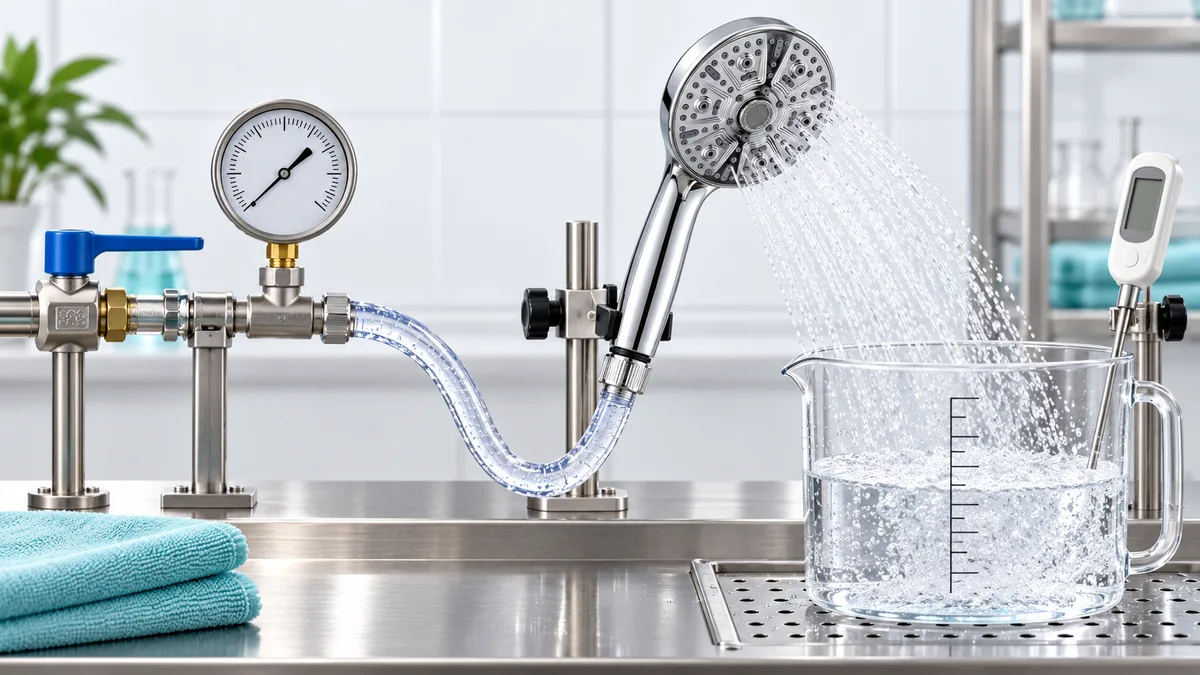
Pressure, flow, temperature, dissolved gas, and plumbing resistance can change how air and water mix, how bubbles form, and what reaches the outlet. A report without operating conditions is difficult to reproduce and should not be treated as proof that every home will receive the same result.
Pressure and flow are related but not interchangeable
Pressure describes the available force in the plumbing system; flow describes the volume delivered over time. A restriction can change flow and local velocity without changing the supply system in the same way.
Record both inlet pressure and delivered flow at the selected spray mode. “High pressure” is a user impression unless a defined pressure value and test point are provided.
Temperature changes the test environment
Water temperature affects physical properties and gas behavior. A cold laboratory sample and a warm shower outlet are not automatically comparable. The temperature at generation and at sampling should be recorded rather than assumed.
The same applies to dissolved gas and water chemistry. Municipal water, softened water, deionized water, and recirculated test water are different matrices.
A minimum condition sheet
| Condition | Record |
|---|---|
| Supply | Water source and relevant treatment |
| Pressure | Location, static/dynamic state, and units |
| Flow | Volume per time and spray mode |
| Temperature | At inlet and/or sample point |
| Gas | Gas source and introduction method |
| Plumbing | Hose, adapter, and restrictions |
| Sampling | Location and elapsed time |
Compare products under matched conditions
A published laser-diffraction study, Couto et al., Minerals Engineering (2009), illustrates that operating conditions and sample chemistry can influence a measured microbubble distribution in its specific dissolved-air-flotation system. It does not establish the performance of a household shower head, but it shows why condition reporting matters.
When comparing two shower heads, use the same supply, hose, valve setting, spray mode, temperature, measurement method, sampling delay, and number of repeats.
Evidence boundary
This guide explains how to evaluate a claim. It does not state that every microbubble or nanobubble product achieves the same result. Product conclusions must match the exact model, method, operating conditions, sampling procedure, controls, and report scope.
FAQ
Common questions
Can a result at one pressure predict every home?
No. It describes the tested setup; performance across other conditions requires additional measurements.
Should flow be measured with the head installed?
Yes for delivered performance, and a supply-only measurement can help identify where restrictions occur.
Why record sample timing?
Bubble populations can change after generation, so immediate and delayed samples may not be equivalent.
Product evidence
Need model-specific specifications or test information?
Tell us the model, market, connection, pressure range, and evidence you need to review.
Request product information